A step-by-step guide to wine tasting
Wine tasting isn’t just for experts. Any wine lover can try it out to conduct their own sensory analysis of the wine. The goal is to describe the sensations you perceive in simple terms, even if it means comparing them later with those of a wine expert.
By following a tasting methodology, you’ll be able to appreciate the different wines you taste and describe the sensations they evoke.
Wine tasting takes place in three stages, involving the eyes, nose, and mouth in succession. You should therefore start by looking at the wine to assess its color, clarity, and the famous “tears.” Next, you’ll use your sense of smell to identify the wine’s aromas. Finally, it’s time to take a sip to judge the balance of its flavors, its tannins, and its finish…
The first step in tasting wine : examining its appearance
Before bringing the wine glass to your nose and mouth, the first step in tasting wine is to observe it. To do this, tilt your glass slightly over a white surface. This will allow you to appreciate all its visual qualities: color, clarity, the presence of tears… These will give you some valuable information about the wine.
For a red wine, for example, a purple hue indicates a wine in its prime youth, while brick-red or brown reflections are the mark of a much more mature wine. In between, there are numerous shades—garnet, ruby, morello cherry, brick red—and they are worth taking a few moments to admire.
White wines exhibit the same distinctiveness and evolve with age from a golden yellow—possibly with some greenish hues—to a yellow with amber-brown highlights, passing through a whole palette of colors: golden, straw yellow, orange-yellow…
You should also observe the clarity of the color. A clear, cloud-free color is a sign of quality. However, some natural sediment may be present without affecting the wine’s quality.
Wait a little longer before taking a sip. Tasting wine requires taking your time so that it can reveal its secrets to you. Swirl the wine in your glass again to observe the tears. You may also be familiar with these small droplets that form on the sides of the glass, known as legs, beads, or pearls. Wine tears are an indicator of the alcohol content in the wine. If the wine has very few tears, you’re looking at a light wine with low alcohol content. On the other hand, thick tears are a sign of a wine rich in alcohol; it will be sweeter and smoother on the palate.
The second step in wine tasting : smelling the aromas
After admiring the wine’s color, it’s time to use your nose to detect its aromas. This is a crucial step in wine tasting, as the aromas are often more intense on the nose than on the palate.
Take a first sniff of your wine, then swirl it in your glass for a few moments and smell it again. This is known as the first nose and second nose.
On the first nose, you should easily be able to discern the wine’s aromatic intensity. Is it powerful and complex, or, on the contrary, weak and subtle?
Off-odors (cork taint, vinegar, or chemical smells) are also easily detectable at this stage and are a more or less pronounced sign of defects in the wine.
With the second nose, you can refine your perception of the aromas released by swirling the wine in the glass. Is the nose floral or fruity? Does it give off brioche or vanilla notes, indicative of aging in oak barrels?
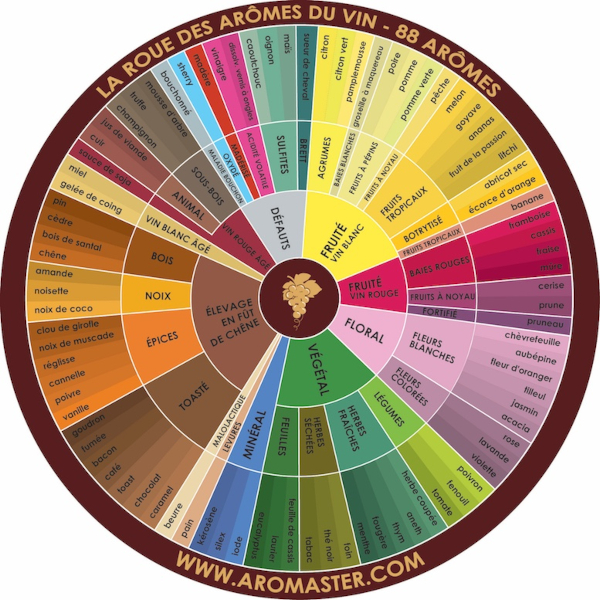
It can sometimes be difficult to put precise words to the olfactory sensations you perceive. Let your instincts guide you and take it step by step. An aroma wheel can be very useful when tasting wine. It will help you accurately identify the different aromas that make up the wine. Start by identifying the main aroma families: fruity, floral, mineral, woody, etc. You can then refine your impressions and describe specific scents like blackcurrant, raspberry, linden blossom, licorice, or grapefruit…
The wine aroma wheel from aromaster.com
Wine tasting, step three : exploring the taste sensations
Finally, to complete your sensory analysis, it’s time to finish your wine tasting by taking a sip.
On your tongue, you’ll quickly detect the wine’s acidic, sweet, salty, and bitter flavors. This is known as the wine’s attack. It can be smooth, crisp, or intense…
In addition, the tannins present in wine, particularly red wines, react with saliva and cause a drying sensation.
You can appreciate the wine’s balance based on the harmony created between the flavors and any tannins.
The taste of wine is not composed solely of the flavors perceived by the taste buds on the tongue. Aromas, once again, come into play to give the wine its unique taste.
They are perceived by the nose through retro-olfaction, that is, rising up from the back of the throat.
This is why you see connoisseurs inhaling air when tasting wine. This is called “gruming” the wine. This involves taking a small sip of wine and then letting in a thin stream of air to oxygenate it. The aromatic notes then burst on the palate, and the tasting sensations are intensified.
Another tasting technique involves swishing the wine around the mouth to mix saliva with the wine and release the flavors and aromas.
It’s up to you whether you prefer to swish or swirl the wine. Try both, and you’ll see which tasting technique you prefer.
Finally, swallow the wine or spit it out, and focus on the sensation that lingers in your mouth. This is called the finish. It can be short, medium, or long.
During these three stages of wine tasting, using your senses of sight, smell, and taste is essential. So avoid tasting wine when you have a cold. The primary goal isn’t to guess whether the wine is a grand cru or a more modest wine. The goal is to determine whether you like the wine or not. So don’t worry about making mistakes in your comments, because there is no such thing as good or bad taste—it’s a very subjective concept.
As you gain more experience, you’ll be able to refine your tasting technique and expand your knowledge. Little by little, you’ll be able to analyze your perception of a wine with greater precision.
See you soon!